Building a multi-source marketing intelligence platform under NDA
A reference build: a marketing intelligence platform that unifies Facebook Ads, Google Ads, and Shopify into a multi-channel marketing dashboard, with competitor analysis, e-reputation, and social listening layered on top. Live in production. Predictive 'next best campaign' module in active development.
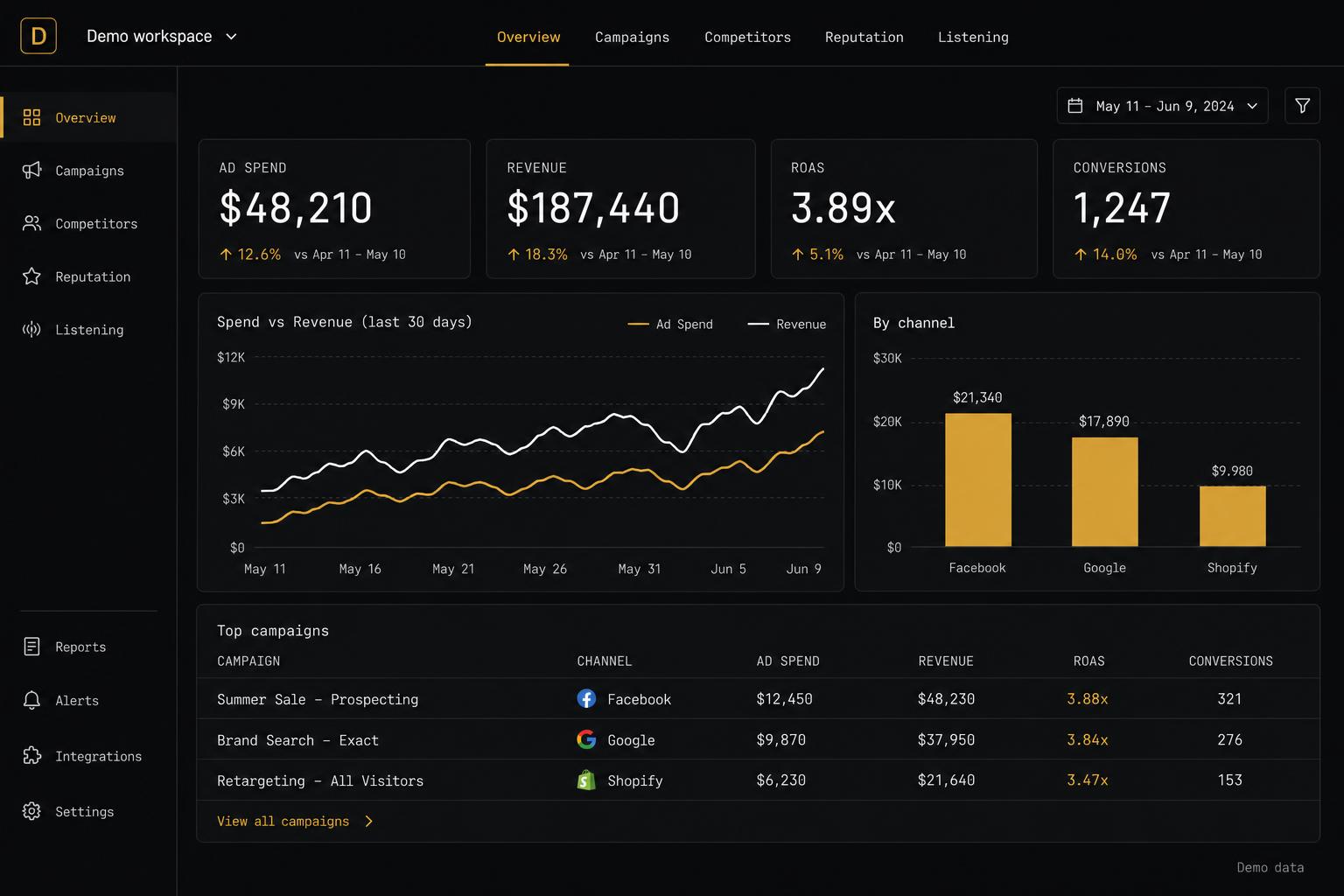
Recreation using synthetic demo data. Real product UI withheld under NDA.
The challenge
DTC brands and the agencies that serve them run reporting across at least three places: the Meta Ads Manager, Google Ads, and Shopify. On Monday morning, someone exports CSVs from all three and stitches them in a Google Sheet. By Wednesday the numbers are stale. By Friday the sheet is abandoned.
The brief was to collapse those sources into one custom dashboard layer where any user could build the view they actually wanted, with the metrics they actually cared about. Then layer three intelligence modules on top: competitor analysis, e-reputation monitoring, and social listening. Five products in one platform, sold as one subscription.
The approach
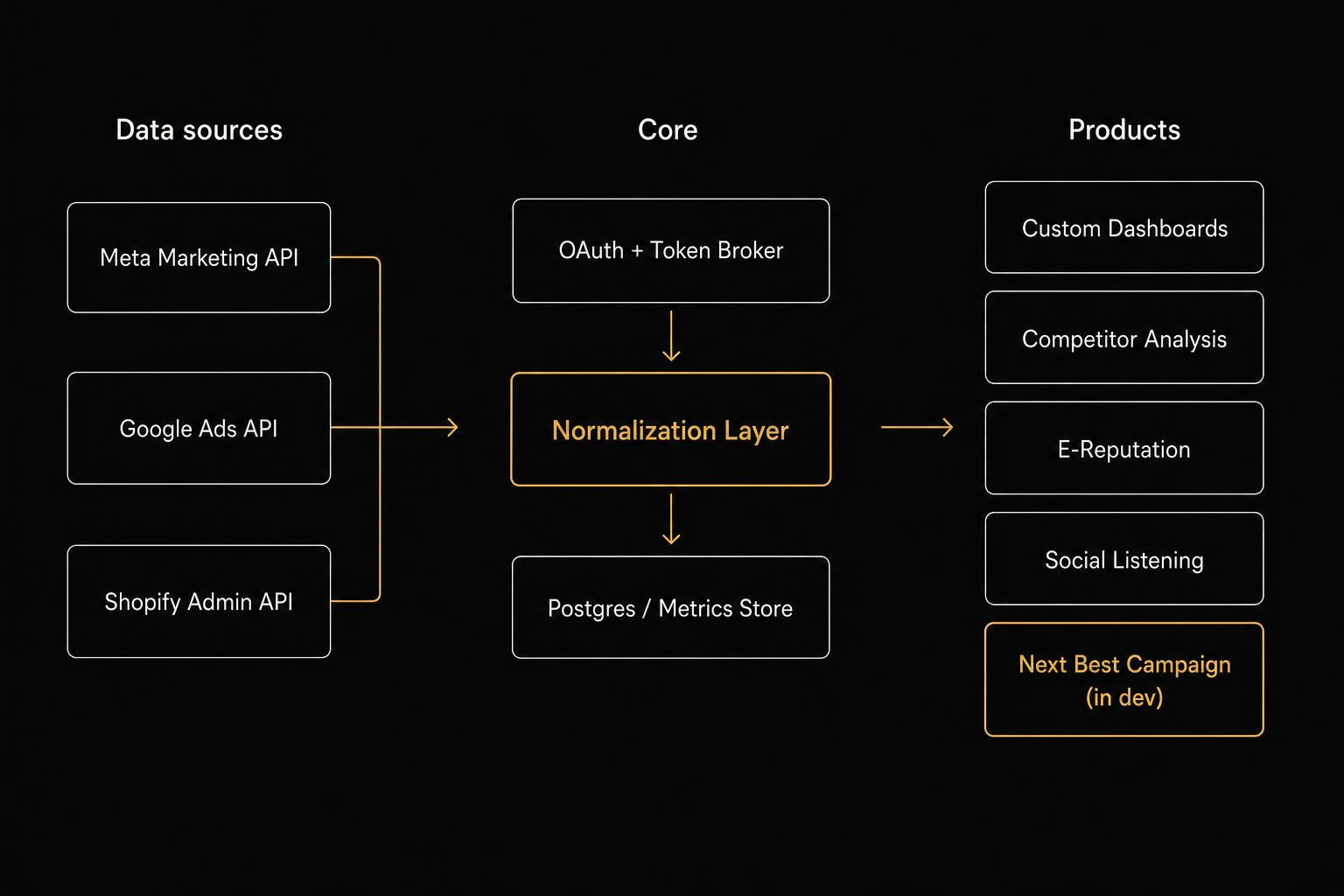
Discovery ran across two weeks with the founder and a paid-media lead who would be the first power user. We scoped v1 around the three data sources that mattered most: Meta Marketing API, Google Ads API, Shopify Admin API. Everything else was a fast follow.
- 01
Normalization layer
Every source dumps into a unified metrics table with a consistent schema: date, account, campaign, channel, spend, revenue, attributed conversions. Meta's attribution windows, Google's auto-tagging, Shopify's order edits — each quirk gets resolved once instead of inside every dashboard widget.
- 02
Token broker
OAuth and token refresh ate more time than any other part of v1. Three providers, three flows, three sets of edge cases for expired refresh, revoked access, and rate-limit backoff. We built a single token broker every connector inherits from. It paid for itself the first time Meta rotated their auth requirements.
- 03
Dashboard builder
Drag-and-drop widgets on a grid, with saved views per user and per workspace. Widgets read from the normalized metrics table, not the raw provider APIs, so a dashboard loads in under a second regardless of how many sources it spans.
- 04
Three intelligence pipelines
Competitor analysis runs scheduled scrapes of public surfaces (pricing pages, ad libraries, listings) and diffs them. E-reputation aggregates Google, Trustpilot, and Facebook reviews into a sentiment-scored feed. Social listening watches keyword and brand mentions across the open web.
- 05
Next Best Campaign (in progress)
A predictive layer reads unified metrics history plus competitor and listening signals, then ranks what to run next. Suggestions are scored on expected ROAS, confidence, and required budget. Validation is happening on a closed beta of paying customers; the model is tuning on their actual outcomes before it ships broadly.
The outcome
Custom dashboards replaced the Ads Manager tab rotation and CSV exports.
Dashboards, competitor analysis, e-reputation, listening. Next Best Campaign in active build.
Reads hit the normalized metrics table, not live provider APIs.
Beyond features, the architectural bet on the normalization layer is paying down. Adding a fourth or fifth data source now is a connector and a mapping, not a re-architecture. The token broker has survived two provider auth changes without downtime. Next Best Campaign is the module the founder believes will move the platform from "useful reporting" to "tells me what to do next" — a different price point and a different category of buyer.
"Most of the engineering work wasn't the dashboards. It was the OAuth dance, the rate limits, and making three APIs agree on what a conversion is. The normalization layer is what makes everything else possible."
Frequently asked questions
What makes a good marketing intelligence platform?+
Three things, in order. First, a normalization layer that resolves how every source defines spend, conversions, and attribution before any dashboard reads the data. Second, custom dashboards the user actually builds (not a fixed template) so the view matches how their team works. Third, intelligence layers on top of the unified data: competitor signals, reputation, listening, and predictive recommendations. Without the normalization layer the rest is unreliable.
Why can't you share the product name or screenshots?+
The client owns the venture and asked us not to. We respect that. The architecture, stack, and outcomes described here are accurate, and we are happy to walk through the work on a call under mutual NDA.
What is the Next Best Campaign module exactly?+
A predictive recommendation layer. It reads the customer's unified metrics history alongside the competitor and listening signals, then ranks candidate campaigns the customer could run next. Each suggestion comes with an expected ROAS range, a confidence score, and a required budget. The model is being trained and validated on closed-beta customer outcomes before it ships broadly.
Why build a normalization layer instead of querying the provider APIs directly?+
Two reasons. First, latency: a multi-channel marketing dashboard that spans three providers and a year of history would take tens of seconds to load if it hit live APIs every time. Second, consistency: Meta, Google, and Shopify disagree about attribution, currency conversion, and refunds. Resolving those disagreements once in the normalization layer means every widget downstream sees the same numbers.
Can Strativra build a marketing data platform like this for another client?+
Yes, with two caveats. We will not clone this client's product for a direct competitor in the same DTC tooling space. And the timeline for a v1 of this scope is measured in months, not the standard 7-day Sprint, because the OAuth and normalization work has irreducible complexity. Talk to us about the brief.
Bring us the ecommerce bottleneck your team no longer trusts.
In thirty minutes, we map the systems, risks, and smallest responsible next step. If custom software is not the answer, we will say so.